Ad Libitum: The Art of Improvisation, Volume 2
Alexander Weimann, harpsichord
TRACKS:
1. Arpeggio (based on Antonio Caldara) 7:09
2. La Monica (traditional) 5:33
3. Toccata VII (based on Michelangelo Rossi) 4:24
4. Toccata 4:23
5. Chaconne (based on Georg Frideric Handel) 11:29
Harpsichord – Ad Libitum
Improvisation is essential to playing the harpsichord, and while I tried to be “correct” in applying baroque performance practice, I was also interested in exploring the liberties it offers.
Arpeggio
Antonio Caldara was one of the musical superstars of 17th century Venice. One of his keyboard pieces consists of nothing more than a plain and seemingly endless series of four-part chords with the initial title “Arpeggio”. The player is invited to come up with their own way of breaking those chords and finding an individual solution to creating some variety.
La Monica
This song tells the story of a young girl forced to become a nun. She tearfully begs her mother to spare her that fate, a recurring theme in folk literature from the Middle Ages to the Renaissance. The theme allows for a variety of harmonizations and can be accommodated in very simple, but also increasingly complex, ways.
Toccata I/II
Baroque music was the basis for playful exploration, models on which curious players could produce works of their own. I took a written-out toccata, the splendid #7 in Michelangelo Rossi’s great collection from sometime in the 1630s, and paired it with a completely unplanned and fully improvised short toccata that was developed in a similarly sequential way.
Chaconne
Compared to Johann Sebastian Bach, Georg Frideric Handel’s keyboard music appears on the page to be less dense, more relaxed, less rigid. I think this is an illusion, a result of expecting Handel’s music to offer a precise prescription of which notes to play. What if Handel’s notation is merely a sketch, like a skeleton to be filled out with flesh and skin? In this version of Handel’s famous “Chaconne”, I improvise/extrapolate in the spirit of the written-out variation. Also, at the very end, I add a cadenza-like passage (taken from one of his other chaconnes) which is then repeated and developed more generously so that in the end the chaconne is as much composed as improvised.
AW
Ad Libitum is available from:





Recorded at CBC Vancouver Studio One
Producer: Denise Ball
Recording/editing: Brian Chan
Mixing/Mastering: Will Howie
Cover photo: © Julien Faugère
Design: Rob Lodder, Corporate Graphics
AW2302 © 2024 Alexander Weimann
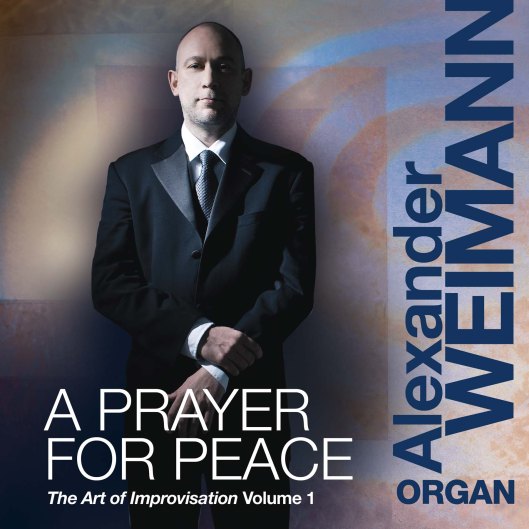
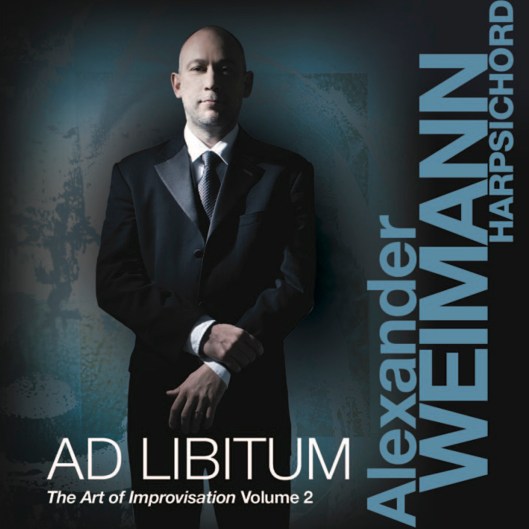
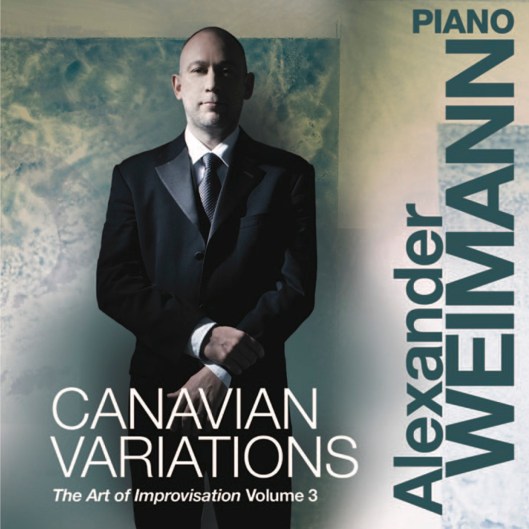
ALEXANDER WEIMANN
The internationally renowned keyboard artist Alexander Weimann has spent his life enveloped by the therapeutic power and beauty of making music.
Alex grew up in Munich. At age three he became fascinated by the intense magic of the church organ. He started piano at six, formal organ lessons at 12 and harpsichord at university (along with theatre theory, medieval Latin and jazz piano.)
He is in huge demand as a director, soloist and chamber player, traveling the world with leading North American and European ensembles. He is Artistic Director of the Pacific Baroque Orchestra in Vancouver and has appeared on more than 100 recordings, including the Juno-award-winning album “Prima Donna” with Karina Gauvin and Arion Baroque orchestra.
Alex offers master classes at European and North American universities and is on faculty at the University of British Columbia.
More than anything, he loves to improvise – something, he says, humans do all the time, just by making conversation.
Alexander Weimann, musicien de renommée internationale, a passé sa vie enveloppé de la beauté et du pouvoir thérapeutique de la musique.
Alex a grandi à Munich. Dès l’âge de trois ans, il a été fasciné par la magie intense de l’orgue d’église. Il a commencé à apprendre le piano à six ans, l’orgue à 12 ans, et le clavecin durant ses études universitaires (parallèlement au latin médiéval, aux études théâtrales et au piano jazz).
Aujourd’hui, il est très recherché comme directeur musical, musicien soliste et chambriste, et il se produit aux quatre coins du monde avec les meilleurs ensembles de l’Amérique du Nord et de l’Europe. Il est directeur artistique du Pacific Baroque Orchestra à Vancouver et figure sur plus de 100 albums, dont Prima Donna — mettant en vedette Karina Gauvin et l’orchestre baroque Arion — qui a été récompensé par un prix Juno.
Alex, qui donne régulièrement des classes de maître dans des universités européennes et nord-américaines, fait partie du corps enseignant de l’Université de la Colombie-Britannique.
Plus que tout, il aime improviser — chose que, selon lui, les humains font tous les jours, par le simple fait de converser.
 Redshift Records